The opinions expressed in this blog are mine, and mine alone. They do not represent the views of the Peace Corps or the United States Government.

Wednesday, April 10, 2013

What We Don't Realize We Know

Sorry for the delay in blog posts.  I have gone on a couple trips within Botswana and will post those pictures shortly.  But now I am in Shoshong for the last 7 months of my Peace Corps service.  I will cease being a Peace Corps volunteer after May 28th.  Pretty exciting!  I am still looking to stay in Botswana but it won't be as a PCV.  There are a lot of reasons for this, but mostly it just isn't the right path for me.  So I am trying to find a job or paid volunteer position that will satisfy my immigration requirements to stay in the country.  It is a challenge but I am looking into many options and hope that I will have a favorable update on this soon!

I have seven weeks left.  Feels like a short amount of time, but it is also a bit awkward.  I can't quite start packing up my house and giving things away because I am still using them.  This is made more complicated by the fact that I don't yet know where I will be going after the seven weeks.  There is no time to start new projects and old projects are wrapping up.  So I am spending most of my time with people I love...hanging out, playing cards, chatting, and going on hikes around Shoshong.  I want to spend the time I have left being happy and engaged with the people around me.

Earlier this week I went into Mahalapye and passed out some cards to district offices that have supported the Peace Corps volunteers in our region.  It is important to say goodbye to the local leadership.  I will be doing that process continually over the next weeks.

Although things are slowing down, there are always new things to do.  World Spine Care opened a clinic in Shoshong last year.  A PhD student named Maria just arrived in Shoshong to do a research study in conjunction with the clinic.  She aims to ascertain the impact of muscular skeletal conditions on people in Shoshong.  How does it affect their ability to do everyday things?  If they are taking care of someone with muscular skeletal issues, what are their challenges?  I sat down with Maria today.  We discussed many things pertaining to her study--everything from who's who in Shoshong to simplifying interview questions.  It was a great discussion.

Before we spoke, Maria sat in on the morning meeting at the clinic.  Before every meeting, the clinic workers sing and pray.  That's just the way it is.  Maria found it beautiful and asked to know what they had been singing.  It made me smile and made me realize something: none of these things are new to me, nor particularly interesting.  Things people do are not cultural or quaint to me.  It's just people being people.  It's life here.  Sometimes I love it and sometimes I find it irksome, the same way I would feel dealing with people anywhere.  But Maria was soaking everything up, clearly engaged and interested in understanding all that she could.

Maria said that she wanted to see a funeral and a wedding.  I invited her to a funeral taking place this Saturday.  Luckily, she asked me what to wear.  I had completely forgotten to tell her the important things, that you have to wear a skirt or dress and cover your head with a hat or scarf.  I forgot to tell her because it didn't occur to me that she didn't know.  The knowledge is innate to me now.

It is impossible to imagine a world in which I didn't know the things that I know.  And it is hard to sometimes remember that other people don't have the same knowledge.  But it was nice to realize how integrated I have become in Shoshong; how much I am just used to the way life is here.  That doesn't mean that I never get impatient or annoyed, but it means that I know the customs.  I know what is right and wrong here and I feel comfortable in this place.  It's a bit remarkable, isn't it?

Saturday, March 2, 2013

Being Young in the Peace Corps

My Peace Corps service is coming to a close.  Three months...and not necessarily counting.  I would like to say I have changed in so many ways--but that's not quite right.  I think my values have deepened and my understanding of the world has broadened.  I am the same person I was when I left the United States, with the ability to view things with different perspectives.  I am sure that a lot of changes within me will be more apparent when I get back to the states.

There is one thing I have been able to reflect upon lately--how this experience has uniquely affected me because of my age.  I finished my time at Brown when I was 21 and came to Botswana at 22.  I had about 11 months while I was working in between college and Peace Corps.  Some young volunteers have even less time than that.  And then there are volunteers who have PhDs already.  In our group, we had a volunteer who was even in his 80s.

Peace Corps is a growing experience for all of us--young and old.  But I think there is something particularly special about being young in the Peace Corps.  Although we have values and opinions galore, they haven't yet been solidified with years of work and life experience.  We are "green" as they say.  Botswana will always be a part of all of us, don't get me wrong.  But what I am beginning to see is that this culture will always be a part of me because I am forming who I am and what I believe within this country. I am becoming an adult in Botswana.  It will alter my life in ways that I can't even foresee yet.

For example, Bots 10 just attended our Close of Service conference.  In one session, we began to process what it may be like adjusting to life back in the states.  The country director (who was a volunteer in Cameroon in the 80s) talked about how people may want to call us to go places and do things, whereas we may find ourselves just wanting to stay home and read on a Saturday.  I am definitely identifying with that.  I can see myself telling friends I am busy...at home just hanging out.  That was never something I did before Peace Corps.

I like slowing down and am not quite sure what a conventional job would be like for me.  Sooner or later I'll probably get one and I'll cross that bridge when I get there.  But I am not too worried about the future.  I enjoy living in the present, focusing on a great book or a superb glass of wine.  I never want to walk passed a sunset without admiring it.  I want to savor things in my life, not rush through it trying to get to some unknown point in which I will have x amount of money and x status that will supposedly bring me some kind of happiness.  We can find happiness in every day.  Frustration, too, of course.  But focusing on the happiness is much more fun.

Being a Peace Corps volunteer has bettered me.  I am so glad I did it as a young woman.  I am looking forward to how my life will unfold from here on out.

Thursday, February 21, 2013

Valentine's Day in Shoshong

I have been working with a handful of dedicated youth about starting a youth body in Shoshong.  The idea behind the youth body is to better advocate for youth in Shoshong.  They are dependent upon government handouts.  One of the goals of the youth body is to spearhead programs that will help the youth to become more economically independent and self-confident.  We decided to hold a meeting to form this youth body, calling all youth in Shoshong to attend.  We planned to have it on Valentine's Day.  In addition to introducing the youth meeting, we thought it would be a good idea to have a theme to the meeting.  So, we decided to hold a candle lighting ceremony to commemorate victims of passion killings in Shoshong.  Unfortunately, there have been a handful of those in the last few months.

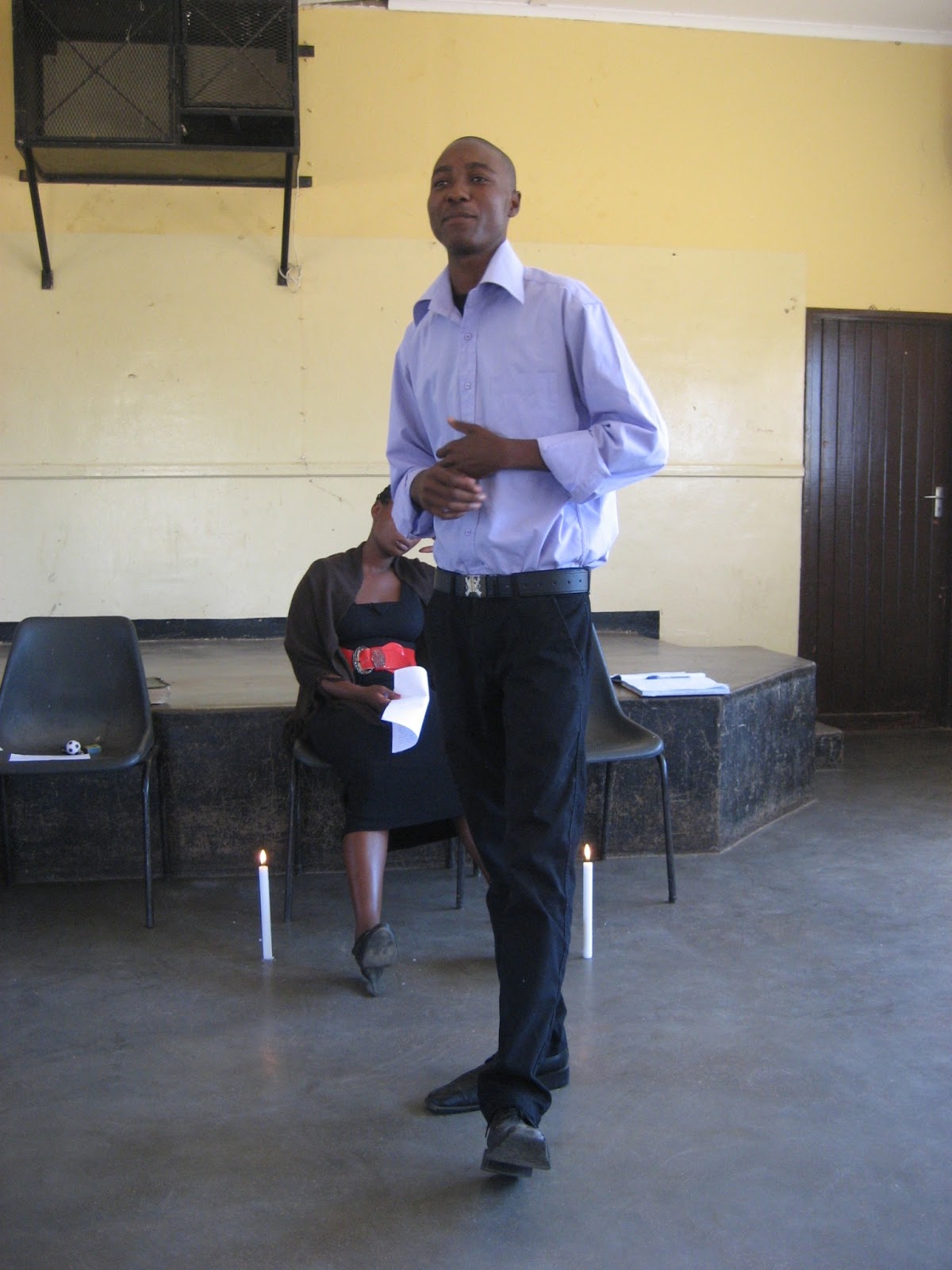
We invited a pastor from Mahalapye, Pastor Kenny, to come and address everyone on the subject of passion killings.  He talked about respect in relationships and how to have a good one.  He is the one standing in this photo.  To his left is Moitshepi Ramotshudi, a member of the Bokaa Village Development Committee.  To his right is Masego (don't know her last name) and Raite Gobopaone.  They are volunteers at the Youth Office.

Some youth in Shoshong listening to Pastor Kenny

The small crowd in Community Hall

Raite describing the purpose of the youth body

February is a difficult time in Botswana because so many people are out at the lands plowing.  So getting people to help with publicizing events poses a challenge.  The people we asked to announce the event around Shoshong with a loudspeaker let us down.  So unfortunately the turnout was pretty low.  But we made the best of it and had a good time.  And some youth heard about the project so hopefully it will travel well through word of mouth.  

In projects like the youth body, it is imperative for a small group to organize it and then invite others in later.  People like joining something that is already established.  With any luck we'll have more chances to announce the group and get better buy-in as time goes on.

Monday, February 18, 2013

Welcoming the Form Fours

In Botswana, schools are divided into three categories: primary, junior secondary and senior secondary.    Primary consists of standards 1-7 (like grades 1-7).  Junior is forms 1-3 (like grades 8-10) and senior has form 4 and 5 (like grades 11-12).  There are exit examinations at standard 7, form 3 and form 5.  The form fours just arrived at Shoshong Senior Secondary School this past week.  The senior teacher in Guidance and Counseling, Mma Jabane, invited me to come address the students on life skills and peer education.  We have been trying to work together for a year with little success because of the busy schedule of the students.  So this was a great opportunity for us to present to all of the 705 form fours.

I worked with my friend Boitumelo to plan the presentation.  We were going to do a drama involving alcohol, drug abuse and teenage pregnancy...a lot of the issues facing the students.  Then we would try to elicit feedback from them and start a discussion, albeit a bit difficult with the large group.  Boitumelo's friend Keagile was also involved.  We thought we were going to have a few more people to do the drama.  But two hours before we were supposed to be at the school, they weren't showing up.  So we had to change our game plan.

We decided that I would begin the day by talking about life skills and peer education.  I would explain that no answer is wrong and that we want to hear what they have to say.  I would introduce the concepts, giving examples of life skills, like decision-making and self-esteem.  In terms of peer education, I would stres the importance of listening in a non-judgmental way.

Then, Boitumelo and Keagile would do mini dramas or conversations between the two of them.  They would act out scenarios between friends that are common in the school--like skipping class because you didn't do your homework, stealing from fellow students, being rude to teachers, getting involved in relationships, etc.  I am happy to say that the day went really well!

Here are some photos:

Boitumelo and Keagile have just finished one of the dramas and are asking for questions/comments from the crowd


A student from the back coming onto the stage to give her opinion


Mma Jabane was also active in adding onto the discussion (pictured left)

From left to right: Boitumelo, me and Keagile...outside of Shoshong Senior Secondary School

Mma Jabane loved our presentation.  She wants us to do it for the form fives as well.  The dramas sparked some interesting discussion.  One thing that students often say is that they want to wait to start relationships until after school.  One girl got up on stage and said that she wanted to be in love, but that love doesn't mean that you have to have sex.  All of the kids were cheering.  It was a great moment, challenging notions of when one should begin to have sex and the importance of sex in a relationship.

The best part for me was that I was on the sideline for most of the time.  I am confident that Boitumelo and Keagile can go into classrooms and lead discussions with students, if I am able to give them some tools to do so before I leave Shoshong end of May.  The best part of our role as PCVs is bringing people together who otherwise wouldn't know about the opportunities to work together.  Now Mma Jabane and these ladies can meet and plan events without me.  That is really encouraging to me.

Wednesday, February 6, 2013

Seen and Not Seen

At some point, we may begin to wonder how we will be remembered in our villages.  Will people say good or bad things about me?  Will they tell the next volunteer that I did a bunch of projects I didn't do?  In many ways, thinking about this is futile.  We'll never know and it can only make our heads spin.

On the one hand, it would be nice to be remembered in conjunction with projects.  On the other hand, having locals forget about me and view all of the work as their own would be amazing.  The "official" point of all of this...Peace Corps I mean...is to empower locals to do things themselves.  So if they look back and think, "Hey I organized a great event!," they will feel a lot better than thinking, "Hey that Peace Corps volunteer put on a great event!"

I began thinking about these things because of a conversation I had with someone in Shoshong.  I had worked with him on some community projects early on in my service.  Although I have invited him to more recent meetings, he has been unable to attend.  This was our conversation over text messaging:

Him: U once had an idea to mobilise funds for a youth center.  Any progress?
Me: No.  It's not right for me to embark on things alone and no one else has shown interest this past year.
Him: Sorry about that.  Which means you gonna leave without at least one project.
Me: What do you mean by that?  I have done many things and assisted many people.  Not everything I do is visible to people.  You can do projects that aren't about buildings...
Him: It's okay.  I was not aware of those projects.  Thanks.

It was pretty discouraging.  This is a man who has known about a lot of my projects.  He is a leader in the village.  And he thinks that I have not had any projects?

Part of me thinks: should any of this matter?  So what if this guy thinks I haven't been doing anything?  I know he is wrong.  My co-workers at the clinic and my other partners in the community know he is wrong.  Regardless of what I tell myself, it struck a chord.  Is this what people generally think?  That I am just taking up space?  After two years of community work, it was hurtful to hear that.

But perhaps his view of Peace Corps is the view of many...that we are here to build infrastructure and do very public projects.  Some volunteers have done that...they have built pit latrines, houses for poor people in their villages, held races and other large events.  We did a large event in Shoshong for Month of Youth Against HIV/AIDS last year.  Those events are great, but most of what we do is behind-the-scenes...teaching at schools, advising someone on a business proposal, etc.  The real sustainable change often comes from one-on-one interactions.  And most people in our villages won't see our daily work.  At the end of the day, that has to be okay because it is the reality.

Because our "work" might not always be visible, the best thing we can do is be good members of the community...we can be respectful to people in a culturally-sensitive way and try our best to attend important events.  And we are making a difference.  I know the friends I have made and the people I have helped will remember me.  That's what has to sustain you.

Wednesday, January 30, 2013

I am a "Lekgoa"

In the past I have written about acceptance of how things work in this culture.  If we get angry everytime we must wait in a government office for a form to be filled out, it will be a loooooong two years.  As I have said previously, there are some days in which these things bother us more than others.  Bringing a book is key in those situations.  Waiting is an easy one...we just need to get used to it.  We need to relax, learn what time we really need to arrive somewhere, and let go of the stress.  I have found that meditation can help a lot with this.

But there are ways in which we are treated that are difficult to accept.  I have written a lot about how hard it is for me when people ask me for money.  One thing I haven't talked much about is being called "lekgoa."  If I never mentioned it, "lekgoa" technically means "vomit from the sea."  It goes back to when the missionaries first arrived in Botswana in the 1700 and 1800s.  Originally the word referred to the British, but now it is a blanket name for all Caucasian-looking people (whether they identify that way or not).

At the bus ranks in Botswana, people constantly call me "English" or "Lekgoa."  For a long time, this bothered me...even that is an understatement.  I hated it.  I would engage in conversations with strangers, telling them that I have a name and not to call me "lekgoa."  It had a very negative connotation for me.  I didn't like being addressed based on the color of my skin.  I'm a person!  The color of my skin is just one aspect of who I am and it frustrated me that it is all people saw when they looked at me.

But those confrontations weren't doing me any good.  It just made my blood boil everytime I tried to take public transport.  I would get so frustrated that Batswana weren't understanding how offensive that word was to me.  Then I realized that I needed to change my attitude.  As much as I believe you shouldn't look at someone and only see the color of their skin, Batswana don't mean it that way.  They call me "lekgoa" in the same way we could call someone a New Yorker in the states.  It is just a recognition of where you come from--your "tribe" of sorts.  Similarly, in Shoshong some people call me "mokaa," or member of the Bakaa tribe.  They mean "lekgoa" in the same way.

Yet, I couldn't figure out how to release myself from the discrimination I felt everytime someone said that to me.  It doesn't happen much in Shoshong...much more in the capital, Gaborone.  I am hoping to live in Gaborone next year, so I realized that I need to change my attitude in order to make it possible for me to happily exist there.

So I decided to talk with a friend of mine about both being being asked for money and being called "lekgoa."  He was saying that I should tell people that I do not have money to give them.  That doesn't mean I have no cash in my wallet, but it means that I cannot give it to them for whatever reason.  That made a lot of sense to me and although I thought of that before, it made me feel better hearing him say it.

Then I told him that I know Batswana don't mean to insult me by calling me "lekgoa," but it does anyway and I didn't know how to change my perception of that.  I asked him how he would feel if he went to the states and they were calling him a name because he is black.  He said that it wouldn't bother him because he is proud to be black and wouldn't care if people assume things about him based on the color of his skin.  He and everyone who knows him would understand that those assumptions are false.  And that is all that matters.  I liked that.

And then it started clicking in my mind...to be content, I need to live within their reality.  I was projecting my understanding of "lekgoa" onto Batswana.  I could only see my understanding of its meaning, not theirs.  But with the recognition that they mean no harm must come my acceptance of that reality.  The only way to live within another culture is to accept that they are going to treat you like they will treat their countrymen.  And sometimes that can be really difficult to integrate into.  Obviously you can tell people when you like to be treated a certain way.  But at the end of the day, accepting their communication styles will result in a less stressful existence.  And who doesn't want that?

Wednesday, January 23, 2013

Youth Boot Camp Dec 27-28

In the first few meetings of trying to start a campaign on gender-based violence in Shoshong, one of the police officers suggested doing a youth boot camp.  In this boot camp, youth would learn about life skills and gender-based violence.  They would also do some exercising.  The police officer, Sebetlela, had the idea to have the camp overnight.  That way the youth would be a bit uncomfortable and it would challenge them.

During the holidays, many youth come back to Shoshong if they live away.  Even if they stay in Shoshong full-time, they are out of school and normally just loitering around.  Sebetlela thought this would be a great time to engage the youth and empower them to understand these issues better.  We hoped that the youth that attended the boot camp could then lead the village in the gender-based violence awareness campaign.

Unfortunately, it was a bit difficult to organize everything on time for the camp on December 27th.  It ended up okay in the end, but Sebetlela was running around the afternoon before the camp to try to secure food and other donations.  We didn't have much time to plan, which made the camp not as effective as it could have been.  But we have fun and learned a lot so we can do a better job planning next time.


Setting up the camp before everyone got there

While waiting for more people to arrive, I showed Boitumelo (one of the participants) how to use a male condom...no need to sit around when you have spare condoms and water bottles!

Gotta eat first!  Here we are cooking magwinya (fried dough...aka fat cakes)

Before the sessions started, the participants and some of the facilitators played games to get everyone excited about the boot camp

One of the first sessions.  Before we get into the specifics of life skills, we thought that the participants needed to do some self-exploration.  These were the questions the facilitator, Rebecca Kowa from the clinic, asked the participants to answer.

Two of the organizers (Sebetlela, the police officer and Boetelo, a councilman in Shoshong) participating in the first exercise.

Most of the participants

More fun in between sessions!

We tried to keep everyone up throughout the night.  The participants talked about self-awareness and self-esteem, spitting your time between social life and work, the difference between violence and abuse, etc.  The youth learned a lot and it brought them closer as a group.  The camp ended at about noon on December 28th.