The opinions expressed in this blog are mine, and mine alone. They do not represent the views of the Peace Corps or the United States Government.

Monday, September 24, 2012

Indonesia: Bali Continued

My fifth day in Indonesia Rachel, Daniel (her boyfriend) and I went driving up the Bali countryside.  We stopped in a place called Tagellelang.  They have beautiful rice fields there.  We had tea and sat enjoying the view.
The three of us

More views of the Tagellelang rice fields.  They are a sight to behold.  And if you can see in this photo, the palm trees are HUGE!

That night, we went to a Mexican restaurant in this cute town called Ubud.  It was SO good!  I actually had cheese enchiladas, almost like I am used to them in the states.  I wanted to get a shirt with this saying on it but it didn't work out unfortunately.

This is an amazing local dessert, made with cheese.  Forget the name unfortunately.

The next day, I rented a car and a driver who took me to the northern part of the island.  The first major stop was this Hindu temple.
Inside the temple

This is a traditional toilet in Indonesia...you squat on the ground and use water to wash yourself as well as flush it down.

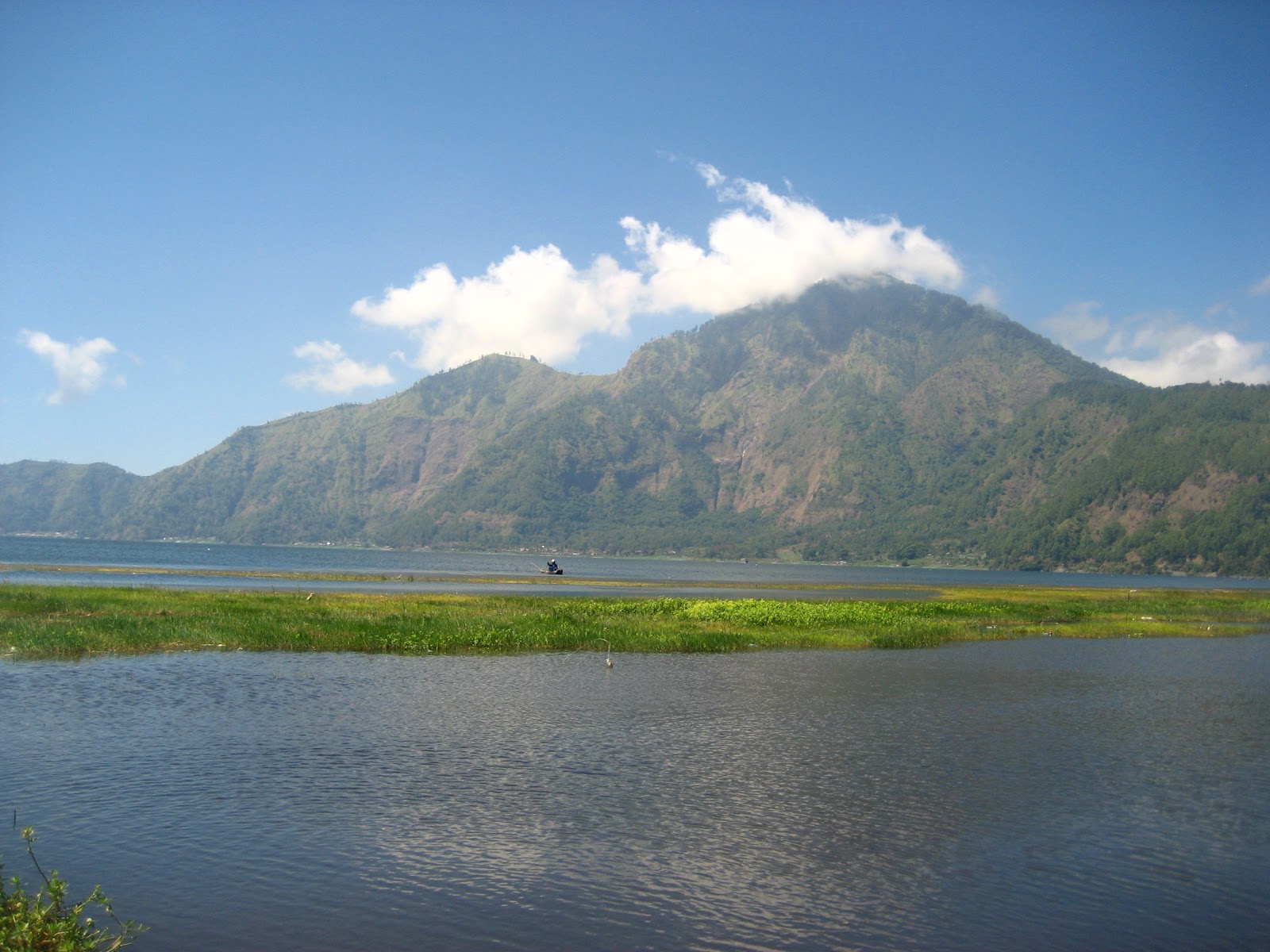
Then I went to Kintamani, which is famous for its two active volcanos and beautiful caldera.  I started to  experiment a bit with taking black and white photos.

More photos of Kintamani


Next, we returned to Ubud and I shopped at the traditional market.  You must haggle the price when purchasing anything.  But by this point, I knew what most things were worth and I had no problem paying a fair price.

They use Absolut vodka bottles to sell Petrol on the side of the road.  This is fabulous.
This is the view from a temple in Uluwatu
 
Rachel, her friends and I went to this place called Echo Beach and had seafood for dinner.  So yummy.  The view and the sunset were spectacular.

On one of my last days, we decided to go snorkeling.  The beach was BEAUTIFUL.  Unfortunately the winds were pretty brutal and the ocean was dragging us around so it was pretty tough to snorkel.  But I took underwater photos of fish anyway and had a great time.  

Eating sate lilit (fish sate) at the snorkeling beach


Bali was absolutely amazing.  I had a great time.  After Bali, I headed to Jogjakarta.  Photos from Jogja will be in the next post...

Sunday, September 16, 2012

Bystander Intervention

On September 13th Botswana welcomed its new batch of trainees, aptly named Bots 13, who will hopefully all become volunteers after two months of training.  Like I did, they will spend that time in Kanye learning Setswana (or other local languages depending on their sites) and generally trying to figure out how to be a volunteer.  Most training sessions are co-facilitated by staff and volunteers.

On the 25th, Karla (a Bots 11) and I are talking with the trainees about how communication styles differ between Americans and Batswana.  Karla made a list of her observations, such as:

  • Americans are more direct, whereas Batswana can say "yes" meaning that they agree, heard what you said and are not agreeing nor disagreeing, or disagree and are too polite to say so;
  • Americans make eye contact and consider it impolite when others do not do so, whereas Batswana think eye contact is not polite especially when speaking to an elder;
  • Americans are usually expressive in our emotions, showing how we feel, whereas Batswana are less likely to show emotion and seem much more subdued;
  • Americans are usually more assertive than Batswana and are oftentimes perceived as aggressive or angry because of it;
  • Americans tend to be uncomfortable in silences, whereas sitting in silence with people around you is normal in Botswana;
  • Americans generally feel much more urgency about getting something done, whereas Batswana do not respect time as much, nor feel rushed to do things;
  • Americans use curse words MUCH more than Batswana.

But today, I realized something as well.  I have spent much of my service trying to de-stress, become more Zen and lessen feelings of urgency in my life as they relate to everyday experience.  I have noticed these changes in myself.  Finding peace and balance in one's life is a goal worth striving for, but I realized that the feelings of stress and urgency are so important.  Batswana do feel stress, for sure.  And not everyone is the same.  But I have observed that stress here is rarely converted into constructive action.  It doesn't push one to get things done more quickly or efficiently.

On this blog, I have rarely expressed thanks for my more "American" qualities, especially the ability to be stressed.  Yet, I am thankful...grateful, really, that stress propels me to action rather than paralysis.  The other day, it was really windy in Shoshong.  A big tree with spikes ended up blowing down into my hair and right arm.  Not only did it hurt, but I was also afraid it wouldn't let me go without someone's help.  Two women were walking about 20 yards away.  I called out to them.  To be honest, I was screaming--not at them, but just in general.  And I yelled out, "Ke kopa thuso," I am asking for help.  They slowly walked toward me, didn't change the pace of their step nor express any concern.  Before they arrived, I managed to pull myself out of the tree.  I was fine--just some strands of hair gone and some pinpricks of blood on my arm.

I didn't feel upset that the women did not come more quickly to assist me.  I have found that bystander intervention is not very strong here in general.  And I am not the only volunteer to experience this.

We have nerves and feelings for a reason.  When we begin to feel stressed or nervous about something, it often signals to us that it is important.  What if the nurses in the hospital emergency rooms in the states never felt any sense of urgency?  Troubling thought.

I welcome the momentary stress that comes with a crisis.  I will run to help you because I care.  And I have glad that I have the ability to have that kind of emotional response.

Friday, September 14, 2012

Indonesia: Jakarta and Bali

In the last couple months, I have written about a few mini vacations I have taken...to Hukuntsi, Kang, etc.  In the beginning of August I went to Indonesia, but this was not a mini vacation.  I went there for about 2 and a half weeks.  The impetus to go was to visit a friend of mine from high school, Rachel.  Rachel has been living in Indonesia for about a year.  We haven't seen each other since the summer we graduated from college so a visit was long overdue.

Needless to say, I had an amazing time.  I spent time in Java and Bali.  On Java, I visited Jakarta (the capital) and Jogjakarta.  In both places, I stayed in hostels.  The majority of the trip was spent on Bali.  Rachel, her dad, her cousin and some Indonesian friends of theirs live in a beautiful house/condo on the southern part of the island of Bali.  Rachel is working at the Four Seasons hotel and her dad is running the International Christian Community (ICC) organization there.  Their house almost feels like unofficial ICC headquarters.  It was great meeting all of Rachel's new friends.  They are beautiful human beings.  When Rachel was at work, I even went out and had meals with them!  I got two massages, went snorkeling, swimming, shopping...ate great food.  I saw the sultan's palace in Jogjakarta, and volcanos and rice fields in Bali.  It was the perfect combination of R&R and sightseeing.  I returned to Shoshong refreshed and rejuvenated.


Around Jakarta - notice all of the motorcycles and mopeds.  They are EVERYWHERE.  Even babies and young kids ride on them behind parents.  There are a lot of accidents in Indonesia because of the way people drive these.  But they are also really efficient and easy to get around with.


I stayed at a hostel in Jakarta.  I ended up traveling around Jakarta with this guy named John who was staying in the same hostel.  It was nice to have a travel buddy.  This is one of our stops...the largest mosque in Jakarta.  Indonesia is a predominantly Muslim country.  We were there during the holy month of Ramadhan in which Muslims cannot eat or drink anything from sun up to sun down.  Not surprisingly, many came to the mosque to pray and sleep to get through the day.  Women and men are separated--women sitting on the far side, men on the near side in the photo.


I love seeing houses of worship, especially churches.  I find them really beautiful.  And I LOVE gift shops.  I go in them whenever I can.  This photo was taken at a church gift shop in Jakarta.  I found a book called "Princess Amelia."  Can you believe it?!  Best day ever!  Clearly I had to purchase it, especially since it cost me a whopping $1.


This is at a night market in Jakarta.  Somehow they were tattooing in the middle of a public square.  I am guessing they were using a generator but I found it really crazy haha.


This is my first photo of Bali.  My friend Rachel is on the left and Emma, one of Rachel's friends from Indonesia, is on the right.  We were going to this place called Krishna.  Krishna is one of the most important gods in Hinduism.  There are statues of her everywhere.  In this context, Krishna is the best souvenir shop in Bali.  In Indonesia, you have to bargain to buy almost anything.  It can be difficult to navigate for foreigners because we don't know the prices.  So it is really easy to rip us off.  Krishna has fixed prices so you can be sure you know what you are getting.  For some reason, they want to count the number of patrons they have.  So, without warning, a young woman comes up and puts a sticker on you.  Clearly a moment to remember.


This is Sisi (left) and Jen (right).  They both live with Rachel and her dad in Bali.  Sisi is Indonesian and works for ICC.  Jen is Rachel's cousin.  She moved to Indonesia about a month ago to teach.  They live in a really modern condo.

Me at the beach in Bali!


On the way to the beach, there are many souvenir shops.  Most of them sold penis-shaped bottle openers of varying colors and sizes.  So bizarre.  I really wonder who buys them...


After the beach one day, I was wandering around and came upon this Balinese ceremony.  Each island in Indonesia has its own, unique culture that is different from Islam or Hinduism.  This is a Balinese ceremony.  They play beautiful music, pray, give offerings to the gods, have water and rice sprayed on them (for lack of a better term).  It was really interesting just coming upon this scene.  And there were so many of them.  I think I saw ceremonies forming almost everyday in different parts of the island.  It is an important part of culture there.


This is another photo from the ceremony.  These are young women dressed in traditional dance outfits.  Unfortunately I wasn't able to see the dancing, but I have heard that it is amazing.

I will put up more photos of Bali in the next post!

Sunday, September 9, 2012

Botswana Hip Hop

Botswana is a really small country.  Less than 2 million people live here.  You know the ability to walk all around NYC and not see anyone you know?  Not possible in Botswana.  Even if you go to Gaborone, the capital, it's inevitable to run into people you know--or at least, people who know you by name even if you can't remember who they are.  Similarly, it's easy to walk through Gabs unaware that you are passing people who are radio personalities and locally famous.

Because I got to be friends with some of the people making music in Gabs, I was around for the making of a music video.  One of the up and coming groups is called Fancy Path Music Group.  A couple guys from FPMG, Motswaki Vic and Khwezi, collaborated with Nomadic, a rapper based out of Johannesburg, to record "For the Love (Motswako Music)."  Motswako is a genre of music--hip hop in Setswana, adding in other languages.  They usually mix English in with Setswana, but can also use Xhosa, Zulu, Kalanga, etc.  It's pretty cool stuff...and it's relatively new.  Rapping in Setswana makes the music accessible to most Batswana and brings it closer to home.  These artists are truly owning their art of hip hop in Botswana by making it personal, infusing their rhymes with metaphors in multiple languages.

The "For the Love" video is below.  And if you watch the whole thing through, you'll see me near the end!  :)


http://www.youtube.com/watch?v=z27Os6xXFVY

If you are interested in learning more about Botswana hip hop, you can check out FPMG on Facebook by searching for "FancyPath Music Group."  BATSOFE is another local group.  Those guys work with FPMG on a lot of tracks as well.  Their blog is batsofe.blogspot.com.

Understanding the music scene in Gaborone and getting to know new artists is not something I thought I would be doing during my service.  But it has been amazing.  Understanding youth culture makes me feel more like I have a life in Botswana.  It feels more real.  This isn't just Peace Corps service.  This isn't 2 years of going to the clinic, going to meetings and coming back to my house, biding my time until I can come back to the states.  I live in Botswana now.  Embracing that and making it my home by becoming close friends with locals has been one of the most fulfilling parts of service.

Tuesday, August 28, 2012

United States and Identity


Many of us [PCVs] have started thinking about what we may want to do after Peace Corps service.  We have exactly 9 months left in Botswana.  Sometimes it seems like a long time.  But lately, it seems incredibly short.  For those of us wanting to go to graduate school, we must think about taking entrance exams, writing essays and submitting applications.  At the time when our service is heating up and we may feel busier than before, our minds begin to take us away from Botswana.

For me, part of the question of “what’s next” isn’t just about what I will do.  It’s also about where I will live.  How do I feel about going back to the states?  I have been talking a bit with some of the volunteers who left Botswana in June.  Some have transitioned back really well, are happily reunited with family, friends and significant others.  Yet, some have really struggled to feel at home in what everyone else considers “home” for us.

People say that home is where the heart is.  For those of us that are in our twenties, Peace Corps may be the first significant thing we did after college.  Although American values shaped us as we grew up, life feels much broader than that now.  When I left for Peace Corps, I was happy to get away from the hustle and bustle of life in the states, and how seriously people took politics and other social issues.  After four years of Brown and a nonstop year of thesis writing, sleep deprivation and over-caffeinating, I was ready for a break.

But instead of feeling ready to get back into that world, I have no desire to.  I enjoy discussions about international affairs and human rights issues are still important for sure.  Yet, I find myself not taking it all too seriously.  And I constantly wonder, what is the big deal?  What is everyone getting so worked up about?  I could say that not having running water for weeks or seeing the way people live puts things into perspective.  But it’s bigger than that.  It’s not just my view of the world or of the United States that has changed.  I am different.  I view things differently.  I value my human relationships more than anything else.  I no longer want to work in a fast-paced, demanding job.  I want to support people; I want to do what I can.  But I know where that begins and where it ends.  I will never again kill myself to get something in on time or skip a meal because I have to work.  Nothing seems that serious to me anymore.

One returned volunteer was telling me that she felt like a foreigner in her own country.  I anticipate feeling similarly.  I did feel that way when I first returned for a few weeks back in February.  People say that you reintegrate, get used to it again.  I am sure that I will.  But for now, Botswana is home.  And in some ways, I think it always will be, even if I no longer live here.

Friday, August 17, 2012

How We View Africa

I just came back from an amazing vacation visiting a good friend of mine in Indonesia.  I spent a day in Jakarta, the capital, a week and a half in Bali and another couple days in Jogjakarta.  I stayed with my friend in Bali and slept in hostels in Jakarta and Jogjakarta.  Hostels are interesting places.  Inevitably, you run into characters from all walks of life.  Many are backpackers treking through the region.  Some are just having short vacations.  Hostels oftentimes organize tours to cultural places that would be difficult to get to otherwise.

On Tuesday, August 14th, I went to Borobudur, a Buddhist temple built in the 9th century (photos to come in other posts).  A van took us from the hostel.  On the way back, one of my fellow travelers and I began talking about our travels and my PC service.  He was from the Netherlands.

At one point, he made a comment to me assuming that policemen and women in Botswana are corrupt.  When I informed him that they are actually pretty good in that category, he was surprised.  He said something like, "Well, when I think about Africa, I think about war and poverty so corruption naturally goes along with that."  I smiled and responded, "Yeah.  That is the problem with our [western] reporting about Africa.  Not all of Africa is the same thing."

I know I should expect this, but it still surprises me.  Not all Westerners think of Africa in this way.  Not all Americans think of Africa in this way.  Yet, it is a trend I see time and time again.  And when I say I am working in HIV/AIDS in Botswana, people say, "Oh yeah, there is a lot of that there, huh?"  Although the HIV prevalence rate in Botswana is rather high compared to other countries in the world, that does not tell begin to tell the real story.  But I know that the more I try to describe the nuances and the beauty that I see here, most people will never get beyond their view of Africa as a war-torn, AIDS-infested continent full of suffering victims.

The victims are there, for sure...as they are everywhere.  But so are the heroes and the intellectuals and the people who would NEVER accept being thought of as a victim.  There are people who care more and work harder and love life more than most people I have met in the states.

We [Americans] get annoyed when people talk about the states in one way.  How many times have you found yourself trying to explain the difference between Texas and New England, California and Indiana?  We are so diverse.  Why do we think that other countries are less so?  Someone may get murdered in New York City one Friday night.  And that story should be told.  But so should the one about the spelling bee and the talent show in the high school ten blocks over.  Africa is no different.

Here is a great article about journalism in Africa and how we can better our perspective and our reporting for a more holistic view of what Africa is really like.  Check it out!

Monday, August 6, 2012

Language Week in Kasane II: Animals!

The perk of holding language week in Kasane was the opportunity to tour through Chobe National Park one of the days.  We saw plenty of animals, learning many of the Setswana words for them.

First, we saw vultures circling.  That is always exciting because it means that there could be a fresh kill ahead.  If there is a fresh kill, there is a greater chance of seeing lions and other cats!  Unfortunately following the vultures led nowhere.


One of the things one instinctively knows is not to yell loudly when going through Chobe.  The animals are all around in their natural habitat.  In order to see them, one wants to AVOID scaring them away.  So, as we were attempting to follow the vultures (which kept circling in different places, never a good sign that there is actually something of interest) we passed a car.  The tourists in the other car shouted, "GO BACK THAT WAY!  LIONSSS!"  We were hoping their yelling hadn't scared away the lions.  So we doubled back near a small watering hole and lo and behold, saw a lion!
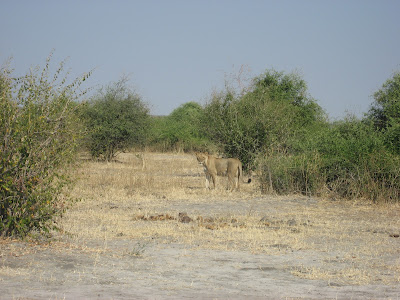
Lion is Setswana is "Tau"


In this photo, she looks relatively docile.  What I couldn't capture was the moment when she thought we were a threat because we were following her in the car.  At that moment, she crouched down like she would pounce on us.  That was pretty scary.  But we turned around.  Crisis averted!

Next, we happened upon some meerkats.  We met many Americans in Kasane studying meerkats.  What exactly they are doing and why I will never know.  But here they are, in case you are interested.


We saw LOTS of buffalo!

Buffalo in Setswana is "Nare"


All of those animals were interesting (especially the lion), but I really wanted to see elephants.  That was my goal for the day.  And they tell you that the best time to see animals is early in the morning or near dusk.  So, as the hours wore on and there were no elephants in site, I began to be a little bummed out.  Then, around noon, as we were heading out, we came upon a whole herd (is that the right word?) of elephants!  They are BEAUTIFUL.  I love them!


Elephant in Setswana is "Tlou"


Elephants are unbelievable creatures.  Looking into their eyes, it's almost like you can see a personality and a soul.  They are so powerful, though, so trying to touch them is absolutely prohibited, especially if a mother has her baby nearby.  They are protective of their young.  Christina knows a lot about animals and she was telling us that elephants have lifespans similar to that of humans.  They live to be around 65 years old.  And when the young male elephants get to be teenagers, they are kicked out of the herd to make their own bachelor herd.  This helps to prevent inbreeding.  Then they must join a different herd.

We hadn't seen zebras throughout the day, so we were surprised to come near some.  Zebras are very skiddish so they turned and ran when they began to hear our car.

Zebra is Setswana is "Pitse yanaga" - "Pitse" means horse


The giraffes were just co-mingling with the elephants.  I have seen giraffes in other places so I didn't take too many photos of them.

Giraffe in Setswana is "Thutlwa"


Later that day, we went on a boat tour.  Pictured below is Goitsemodimo, our tour guide.  Goitsemodimo means "to know God."  All Setswana names have meanings, oftentimes related to God.


Amanda, me, Christina and Shelley.  I was DYING to buy Shelley's hat but I haven't been able to find it yet.

Too many elephants are never enough!


On the boat tour, we were able to see some animals that we didn't see much of on land in Chobe.  One was the crocodile.  The water was clean and beautiful, but unswimmable (I don't think that's a word but I like it so I am going to use it) because of crocs.

Crocodile in Setswana is "Kwena"

Christina, Amanda, Shelley, me and Patrick with elephants in the background


Finally we saw hippos!  Goitsemodimo told us that hippos are very territorial so we couldn't get too close in the boat.  Hippos are known for destroying boats and attacking when feeling even the slightest bit provoked.

Hippo in Setswana is "Kubu"

Hippo yawn!

All in all, the Kasane trip was amazing.  Kasane is also right across the border from Victoria Falls.  So if you visit the Falls, I urge you to come down and see some of the animals in Kasane.  Seeing animals in their natural environment, away from the zoo, is really special.